Introduction to Programming
Programming fundamentals in Python: control flow, functions, memory diagrams, and unit testing.
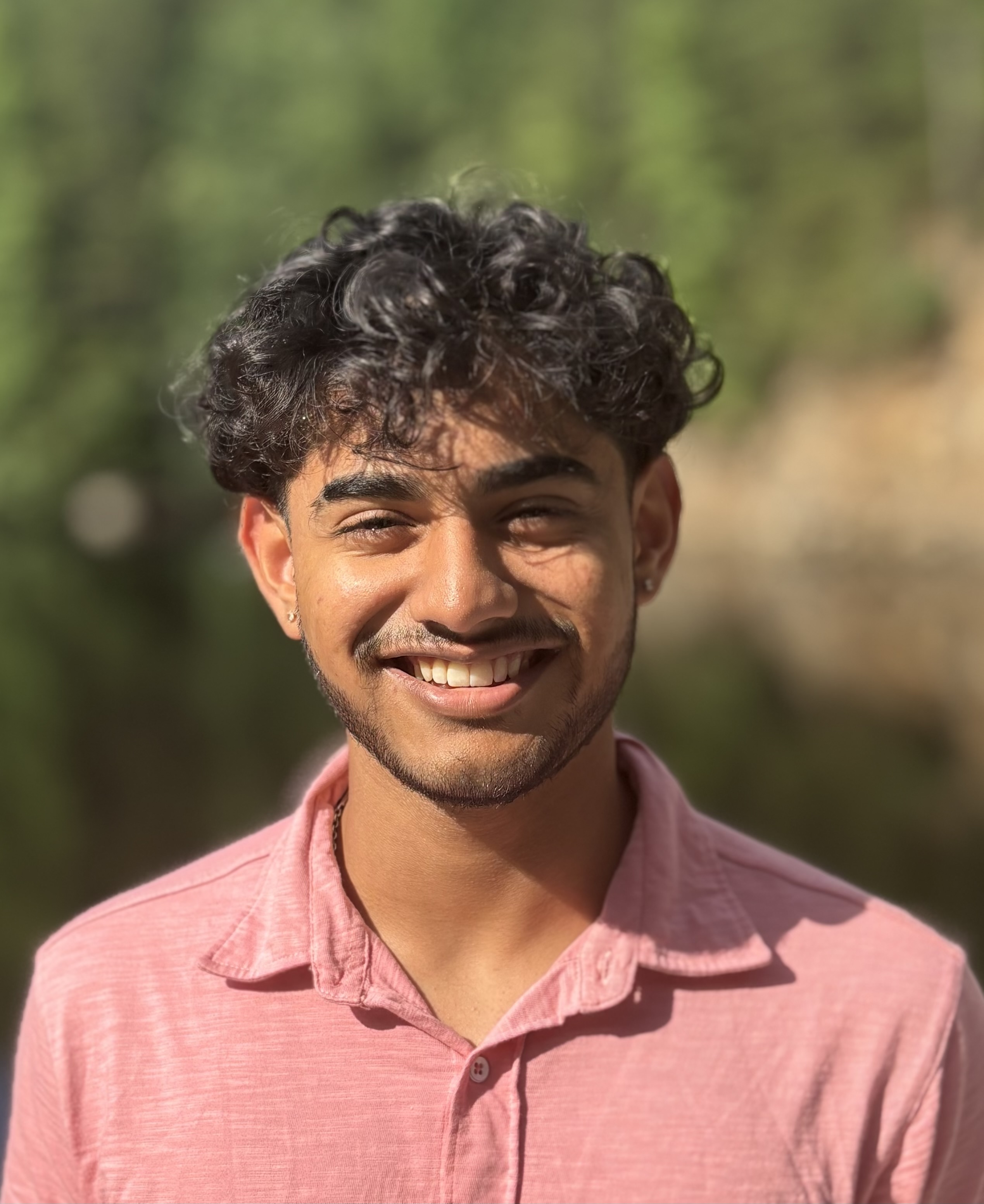
Hello, I'm
Computer Science student at UNC Chapel Hill. I work on applied AI research at the CS department and build web and systems projects on my own time.
I'm a junior studying Computer Science at UNC Chapel Hill. I like building things and figuring out how to make them actually useful.
I'm currently doing applied AI research at UNC, working on MAIA, an AI programming tutor, and I've previously worked in enterprise software and helped start a student-run credit union.
When I'm not coding, you'll probably find me watching Carolina basketball, working on some random project, or getting coffee on Franklin Street.
Coursework I've completed at UNC, plus what I'm taking now.
Programming fundamentals in Python: control flow, functions, memory diagrams, and unit testing.
Linked lists, trees, hash tables, and graphs, with asymptotic analysis for comparing implementations.
C programming, pointers, and manual memory management, along with how source code gets compiled, linked, and executed.
Propositional logic, proof techniques including induction, combinatorics, and introductory graph theory.
Object-oriented design in Java: inheritance, interfaces, abstraction, and common design patterns.
Digital logic, assembly language, and processor design, including pipelining and the memory hierarchy.
A semester-long team project for an external client, covering requirements gathering, sprint planning, and code review.
Calculus in several variables: partial derivatives, gradients, vector fields, and multiple integrals.
Front-end and full-stack web development.
Languages, frameworks, and tools I've worked with.
Research, internship, and student organization work.
UNC Department of Computer Science
Jan 2026 – Present
Intapp · Enterprise CRM
Jun 2026 – Aug 2026
Carolina Students' Financial
Apr 2025 – May 2026
Personal projects built outside of coursework.
August 2026
A caching layer that serves semantically similar LLM requests from earlier responses instead of re-running inference. I implemented the HNSW vector index from scratch; it reaches 99.5% recall@1 at 1,000 vectors and runs 1.5× faster than brute force at 10,000. The similarity threshold is calibrated against a 194-pair labeled evaluation set using an asymmetric cost model, which holds the wrong-match rate at 7%. Deployed on AWS with CloudFormation, least-privilege IAM, and budget-triggered shutdowns.
View on GitHub →April 2026
A self-hosted LLM stack running on a home RTX 3060 Ti, built on Ollama, Open WebUI, and Docker, and reachable from authenticated devices over a Tailscale VPN. A two-way sync keeps OneDrive files indexed in a Chroma vector store for retrieval, using event-driven watchers with 2 to 5 second latency and a five-minute reconciliation loop with MD5 state tracking to recover missed syncs.
View on GitHub →October 2025
A Next.js and FastAPI web app that recommends workout intensity based on the surface gravity of a given exoplanet. The recommendations come from linear regression models trained in scikit-learn on 33,000+ NASA exoplanet records, validated with 10+ visualizations of the gravity-to-intensity mapping. Placed first out of 20+ teams at the Carolina Data Challenge.
Visit the site →